
DeWitt County Parole and Probation
Probation is a court sentence supervised through DeWitt County Court Services. Parole and mandatory supervised release, often shortened to MSR, follow an Illinois prison term and are supervised by the Illinois Department of Corrections Parole Division under conditions set by the Illinois Prisoner Review Board. Pretrial supervision is different again. It applies before a criminal case reaches final disposition and can allow a person to remain outside jail while the case proceeds.
The legal source matters more than the casual label. A DeWitt County docket showing probation should lead to the county probation office and court file. An IDOC profile showing parole or MSR should lead to IDOC. Neither record proves the other form of supervision.
| Supervision | Who orders it | Who oversees it | Best public evidence |
|---|---|---|---|
| Probation | DeWitt County court | DeWitt County Court Services | Court docket or clerk record |
| Parole or MSR | Illinois law and PRB conditions | IDOC Parole Division | IDOC status plus PRB or court discharge record |
| Pretrial supervision | Court before disposition | Statewide Pretrial Services | Release order and court docket |
- Parole
- Conditional release from prison under state supervision, used chiefly for older indeterminate sentences.
- MSR
- Mandatory supervised release, the supervision period that follows many determinate Illinois prison sentences.
- Probation
- A court sentence served in the community under county court-services supervision.
- Discharge
- The formal end of supervision or sentence, not merely departure from a jail or prison.
Verify DeWitt County Supervision
Begin with the custody system that released the person. The sheriff's jail line can confirm current incarceration, but it is not a historical supervision lookup. For a DeWitt County court case, the official Circuit Clerk directs users to Judici and retains the court record. For a state-prison term, the IDOC Individual in Custody Search can display people who are imprisoned or still on parole or MSR. A person who has fully completed the sentence may no longer appear online.
- Search the DeWitt case by name or case number and read the sentence, release order, probation entry, and later satisfaction entries.
- If the docket shows a prison commitment, search IDOC by surname, IDOC number, or birth date and match all available identifiers.
- Read the status literally. Parole or MSR means prison release with state supervision, not final sentence completion.
- For probation, confirm lawful public details with the Circuit Clerk or county probation office. There is no public list of everyone supervised locally.
- If a completed IDOC term no longer displays, request archived current or former status, admission, release, and discharge information from IDOC.
- Use an originating agency record to resolve any conflict with a notification or secondary source.
The broader DeWitt County released-person search and release-record path appears on the home search. It distinguishes a physical exit from a transfer to another authority.
Note: A court release order gives legal authority, but the jail discharge record supplies the physical exit time and destination.
DeWitt County Probation Office
The DeWitt County Probation Department reports to the court and provides dispositions and supervision for people placed on probation. Its listed work can include pretrial release, diversion, detention, intensive supervision, DUI and community-service matters, and family-court services. Contact is appropriate for authorized reporting instructions or questions tied to an identified case. The office is not a public roster of probation clients.
201 W. Washington St.
Clinton, IL 61727
Phone: 217-935-7830
Fax: 217-935-7838
Email: Dbeery@dewittcountyil.gov
The research identifies David Beery as chief probation officer. A case docket remains the sound public route for determining whether the judge imposed probation. Pretrial supervision at the courthouse is handled through the Illinois Office of Statewide Pretrial Services and should not be mislabeled as probation after conviction.
The official county probation page shows the local office and its role. Its contact details support direct routing, while the court file supplies the legal status.
View the DeWitt County probation source used for this office information.
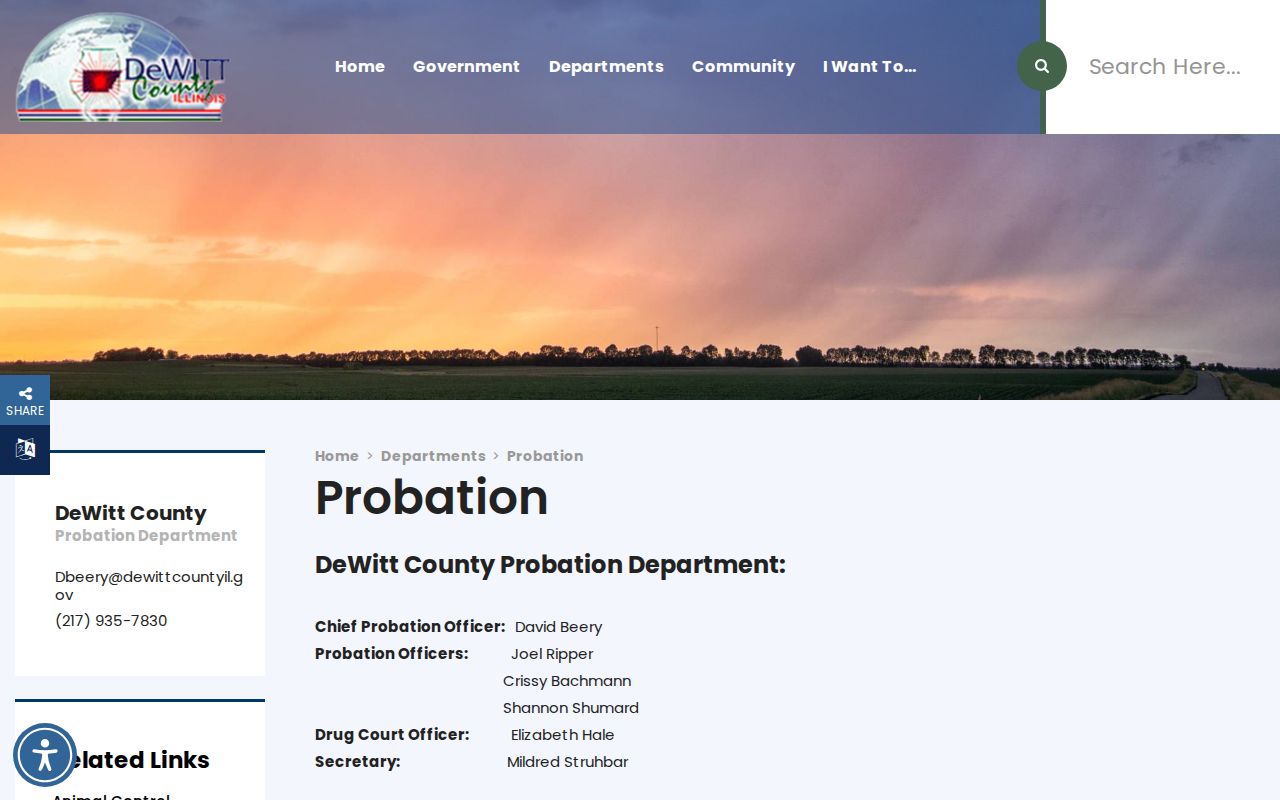
The captured county page helps separate local probation from the statewide parole system.
DeWitt Parole Conditions and Violations
Under 730 ILCS 5/3-14-2, IDOC supervises parolees and releasees. The Prisoner Review Board sets conditions. Conditions can concern reporting, an approved residence, travel, treatment, or other case-specific duties. They should be read from the actual order, not guessed from a status label. Interstate transfer of supervision runs through the compact process, so an address in another state does not by itself mean supervision ended.
An absconder is a supervised person reported as having stopped complying with required contact or location duties. The research found no public DeWitt County absconder list. Reports about an apparent violation, warrant, or urgent safety issue should go to local law enforcement or IDOC at 217-558-2200. A VINE change can alert a registered user to a custody event, but it does not decide whether a violation occurred.
DeWitt Release Revocation Hearings
The Illinois Prisoner Review Board schedule and its revocation results document distinct stages. The current-month facility docket is generally posted about a week before the hearing date. At a final hearing, a three-member panel uses a preponderance standard and decides by majority. That standard asks whether the evidence makes a violation more likely than not.
Possible results include no violation with release resumed after an approved plan, a violation followed by return to release status with the same or added conditions, or revocation. After revocation, IDOC recalculates the release date. A schedule shows that a proceeding is planned. It does not prove the result or establish a completed return to the community.
Older indeterminate-sentence parole interviews and modern revocation matters also must not be merged. Most people with determinate Illinois sentences leave prison by operation of the sentence and lawful credits, then serve MSR. PRB sets conditions rather than choosing every modern release date.
DeWitt Supervision Final Discharge
Leaving prison for parole or MSR begins a supervised phase. Final discharge ends it. The PRB may grant early final discharge after considering compliance, progress, risk and needs, case facts, offense seriousness, participation, public safety, statements, and the Parole Division recommendation. The PRB early final discharge page explains that process.
Under 730 ILCS 5/3-3-8, the discharge order takes effect when entered. It is sent to the committing-court clerk, who records satisfaction of the sentence and commitment. That clerk entry can remain useful after the active IDOC profile disappears. If online results are absent after known completion, seek the IDOC archive record and the committing court's discharge or satisfaction entry.
Keep the prison exit and discharge evidence in sequence. The IDOC profile may show a release to MSR, a later status, and projected fields. A PRB order may end supervision early. The court clerk's entry then records that the sentence and commitment are satisfied. No single earlier projected date substitutes for this chain. If the IDOC profile is gone, provide the archive request with the full name, birth date, IDOC number when known, reception year, institution, committing county, and relevant dates.
An approved residence and interstate transfer process can shape the start of supervision. They do not change probation into parole or turn a projected date into an actual exit. Read the status, agency, and date together.
Note: “Released on MSR” confirms departure from prison, while “final discharge” confirms the later end of the supervised sentence.
Property Records After DeWitt Release
Release questions sometimes concern belongings or medication rather than supervision status. The 2024 DeWitt jail inspection checklist asks whether the jail permanently keeps an itemized, signed personal-property receipt and records medication released with the detainee. Those standards identify useful record categories. They do not prove that a specific person received a specific item.
Ask for the actual receipt or medication-release entry tied to the named booking and release. A county FOIA request should describe the existing record, person, and date range with care. Keep that property inquiry separate from the probation or parole status inquiry. The sheriff record documents the jail handoff, the court record documents probation, and IDOC documents state supervision.
DeWitt Supervision Record Conflicts
When records appear to conflict, keep each status tied to its source and date. A county probation order does not establish state parole. An IDOC parole or MSR profile does not establish a county probation sentence. Pretrial services concern a person released before final disposition and must not be treated as either post-conviction status.
Start with the DeWitt court docket for probation or pretrial conditions. Use IDOC for parole or MSR, then look to the Prisoner Review Board for a revocation or early final-discharge action. A later clerk entry recording the sentence and commitment as satisfied can confirm final discharge. If a public profile is absent after completion, request the archived state record rather than assuming supervision never existed.
Public Record Search
Sponsored Results